

Transportation & Logistics
Keep Cargo, Fleets and Passengers Moving Under Attack.
Security for ports, airlines, logistics and fleet operators whose operations depend on third parties and connected systems.
Executive Summary
- 01Logistics security is about protecting the systems that move cargo and passengers, and the partner links that feed them.
- 02Most serious incidents enter through a vendor, a remote session or a connected device, then spread across a flat network.
- 03Recovery is decided before an attack, by tiering partners, separating networks and rehearsing manual fallbacks.
TRANSPORT & LOGISTICS · Risk Drivers
Ransomware on operations, third‑party integrations, connected fleets.
- Primary Attack Vectors
- Ransomware on operations, third-party and fleet compromise
- Operational Consequences
- Halted operations, cargo and revenue loss
In Depth
Security in Transportation & Logistics, Explained
Map the Operational Dependency Chain
Security starts with knowing which systems actually move cargo and passengers: terminal operating systems, warehouse management, dispatch, telematics, ticketing and customs interfaces. Each connects to partners through APIs, file transfers, vendor accounts and remote support sessions. A dependency map ranks these links by operational consequence, not contract value. It shows which partner failure would stop a berth, a gate, a flight turnaround or a delivery run. That ranking tells you where to apply controls first and which processes need a manual fallback when a system or partner goes dark.
Contain Third‑Party and Remote Access
Vendors, agents, maintenance contractors and drivers all connect in. Effective security replaces broad network trust with narrow, brokered access: named accounts, multifactor authentication, recorded vendor sessions and time-limited approvals. Segmentation separates corporate IT from operational networks such as crane controls, baggage handling and yard automation. Partner connections land in a controlled zone, never on the flat network. If one partner is compromised, the attacker meets a boundary instead of a path to dispatch. Shared credentials and always-on tunnels are the first things to retire.
Detect and Recover at Operating Speed
Monitoring looks for the behaviors that precede ransomware: unusual remote administration tools, credential theft, mass file changes and disabled backups. Alerts carry operational context, so analysts know whether a flagged server runs a gate system or a back-office report. Recovery plans define the minimum viable operation: which systems return first, which manual procedures bridge the gap, and which backups are protected from tampering and tested. Exercises build recovery speed, because a plan nobody has rehearsed rarely holds when dispatch screens are dark.
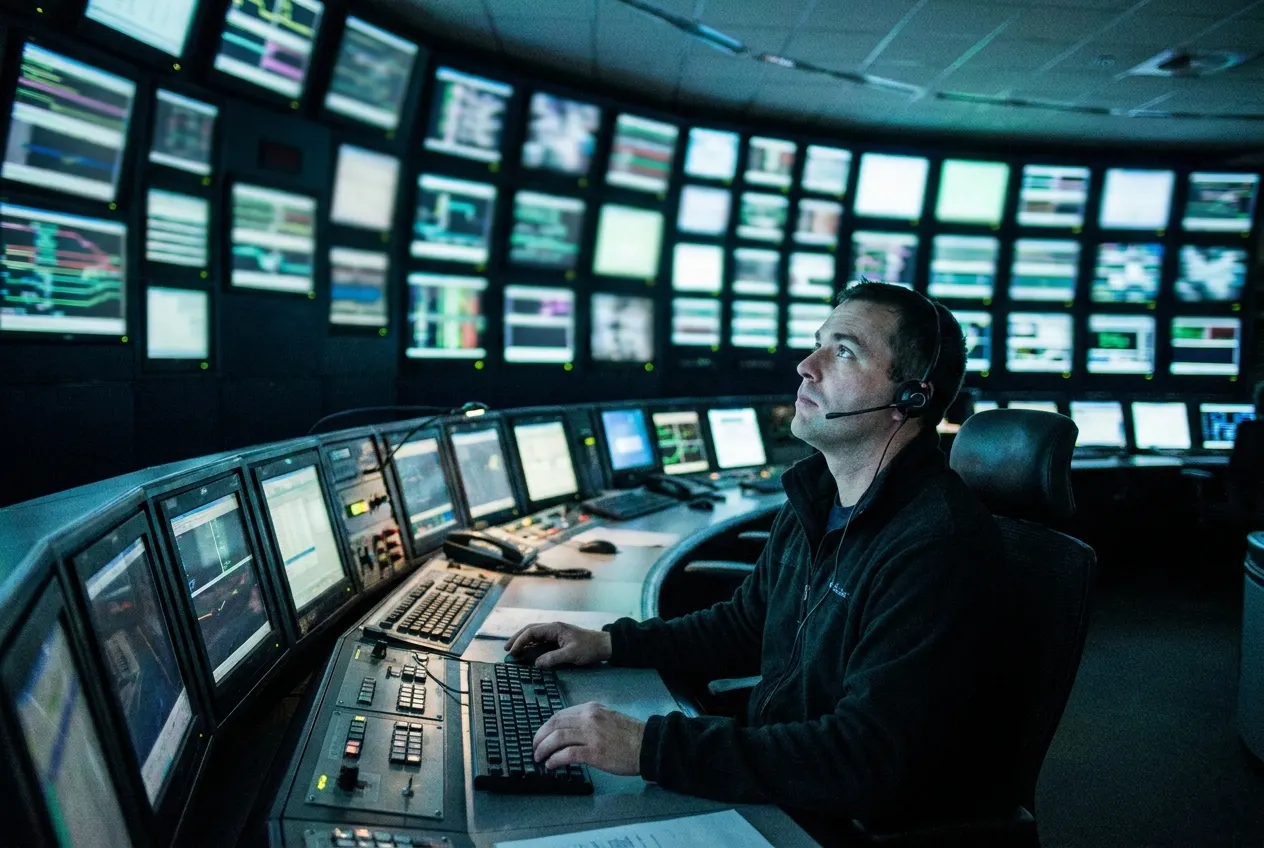
In logistics, the weakest partner connection sets the real perimeter, and recovery rehearsal sets the real downtime.
Threat Scenarios
What It Looks Like in Practice
Ransomware on Terminal or Warehouse Systems
How It Shows Up
Gate, yard or picking systems freeze while file shares show mass renaming. Backup consoles may already be locked.
Response
Isolate affected segments, protect surviving backups and switch to documented manual procedures while priority systems are restored in agreed order.
Compromised Logistics Software Vendor
How It Shows Up
A trusted integration begins sending unusual queries or pushing unexpected updates into booking or tracking platforms.
Response
Tiered vendor controls limit what the integration can reach, and monitoring flags abnormal behavior so access can be suspended quickly.
Fleet Telematics Compromise
How It Shows Up
Vehicle units report false locations or accept unauthorized configuration changes, and fleet portal logins appear from new places.
Response
Segment telematics platforms, enforce strong authentication on fleet portals and review device management paths for exposed services.
Freight Payment Diversion
How It Shows Up
A carrier or broker email thread changes bank details just before a large settlement.
Response
Require out-of-band verification for any payment detail change and monitor mailboxes for forwarding rules and unfamiliar sign-ins.
| Scenario | How It Shows Up | Response |
|---|---|---|
| Ransomware on Terminal or Warehouse Systems | Gate, yard or picking systems freeze while file shares show mass renaming. Backup consoles may already be locked. | Isolate affected segments, protect surviving backups and switch to documented manual procedures while priority systems are restored in agreed order. |
| Compromised Logistics Software Vendor | A trusted integration begins sending unusual queries or pushing unexpected updates into booking or tracking platforms. | Tiered vendor controls limit what the integration can reach, and monitoring flags abnormal behavior so access can be suspended quickly. |
| Fleet Telematics Compromise | Vehicle units report false locations or accept unauthorized configuration changes, and fleet portal logins appear from new places. | Segment telematics platforms, enforce strong authentication on fleet portals and review device management paths for exposed services. |
| Freight Payment Diversion | A carrier or broker email thread changes bank details just before a large settlement. | Require out-of-band verification for any payment detail change and monitor mailboxes for forwarding rules and unfamiliar sign-ins. |
Regulatory & Operational Challenges
Logistics chains connect many partners, each a potential route into operations.
Downtime is measured in halted cargo and lost revenue, so recovery speed matters.
Relevant DAAKYI Capabilities
Services for Transportation & Logistics
Delivery Approach
Priority Capabilities Across GUIDE, SECURE and OPERATE
GUIDE
Supply-chain and third-party risk.
SECURE
Segmentation, secure remote access.
OPERATE
SOC monitoring, disaster recovery.
Methodology
The Method, Step by Step
- 1
Map Dependencies
Inventory the systems, data flows and partner connections behind each operational process. Record which processes tolerate an outage for hours and which cannot. Include shadow integrations, spreadsheets exchanged with agents and remote support tools that operations teams adopted without security review.
- 2
Tier Partners
Group suppliers and integrators by operational impact and access level. High-tier partners receive deeper due diligence, contractual security requirements and evidence checks. Low-tier partners receive lighter review. Also identify fourth parties, the subcontractors your vendors rely on, where they hold access or data.
- 3
Segment and Broker
Define zones for corporate IT, operational technology, partner connections and fleet platforms, with controlled conduits between them. Route remote and vendor access through a brokered gateway with strong authentication and logging. Remove direct internet exposure from control and dispatch systems.
- 4
Monitor and Hunt
Build detection use cases against known adversary behavior, using MITRE ATT&CK tactics as a checklist. Prioritize remote access abuse, credential theft and backup tampering. Add operational context to every alert, and hunt periodically for activity that automated rules miss.
- 5
Rehearse Recovery
Run exercises that simulate losing dispatch, ticketing or terminal systems. Test restoration from protected backups against agreed recovery targets. Practice manual operations, customer and regulator communication, and decision authority. Record gaps and fix them before the next exercise.
Deliverables and Roles
What You Receive, and Who Does What
| Deliverable | Purpose |
|---|---|
| Operational Dependency Map | Shows which systems and partners each critical process relies on, ranked by consequence of failure. |
| Partner Risk Tiering Register | Records every supplier's tier, access, evidence reviewed and open issues. |
| Segmentation and Remote Access Design | Defines zones, conduits and brokered access paths between IT, operations and partners. |
| Detection Use‑Case Catalog | Lists monitored behaviors mapped to adversary techniques, with owners and response steps. |
| Recovery Runbooks and Exercise Report | Documents restoration order, manual fallbacks and lessons from each rehearsal. |
| Role | Responsibility |
|---|---|
| Chief Operating Officer | Sets how long each operation can stop and approves the manual fallbacks that recovery depends on. |
| Chief Information Security Officer | Owns the control design, risk register and reporting on partner and ransomware exposure. |
| Procurement or Vendor Manager | Enforces security clauses and evidence requirements when suppliers are selected and renewed. |
| Provider Incident Lead | Coordinates containment, evidence handling and restoration with operations during an active incident. |
Maturity Model
Where Organizations Typically Stand
Stage 1
Reactive
Vendor access is shared and unmonitored, networks are flat, and backups have never been restored under pressure.
Stage 2
Defined
Partners are tiered, remote access is centralized, and recovery plans exist on paper.
Stage 3
Managed
Segmentation is enforced, detections are tuned to operational context, and exercises run on a schedule.
Stage 4
Resilient
Partner risk is monitored continuously, manual fallbacks are routine, and recovery performance is measured against agreed targets.
Frameworks and Regulation
The Standards That Shape This Work
NIST CSF 2.0
Its six functions, Govern, Identify, Protect, Detect, Respond and Recover, give operators a structure for partner risk, segmentation, monitoring and recovery.
IEC 62443 and NIST SP 800-82
Both address securing industrial and operational systems, including zone and conduit design for terminals, yards and automated handling.
ISO 22301
It guides business continuity management, supporting recovery targets, exercises and manual fallback planning for halted operations.
Ghana Cybersecurity Act, 2020 (Act 1038)
It provides for designating Critical Information Infrastructure and for incident reporting, which can apply to operators of ports, airlines and other designated services.
Buyer Guidance
Choosing the Right Provider
What to look for
- Look for a provider that starts from your operational processes, not from a generic asset list.
- Expect experience with operational technology constraints, where patching windows are short and downtime is costly.
- Require evidence that recovery has been tested, not only that backups exist.
- Prefer clear handling of partner access, including how third-party sessions are approved, recorded and revoked.
Questions to ask a provider
- How do you rank our partners by operational impact?
- How would you separate our operational networks from corporate IT?
- What does a recovery exercise for dispatch or terminal systems involve?
- How do alerts reach our operations team, and who decides to halt a system?
Technical Detail
For Architects and Security Leads
Zones and Conduits for Ports and Fleets
IEC 62443 describes grouping assets into zones with shared security requirements, linked by conduits that carry controlled traffic. In logistics, a terminal might use separate zones for crane controls, gate automation, the terminal operating system, corporate IT and partner interfaces. Each conduit permits only named protocols between named systems, with logging at the boundary. Vendor maintenance enters through a jump host in a dedicated zone, using multifactor authentication and session recording. Inbound internet exposure to control systems is removed, and data leaves through brokered interfaces. This limits ransomware movement because a compromised office workstation cannot reach yard or dispatch controllers directly.
Ransomware-Resilient Backup Design
Ransomware crews target backup infrastructure before encrypting production systems, so backups need separation. Keep at least one copy offline or immutable, protected by credentials that are not part of the main directory. Back up not only data but also configurations, database schemas and integration settings for dispatch, ticketing and warehouse platforms. Document the dependency order for restoration, since a terminal system may need identity services, databases and network rules first. Test restores in an isolated environment and record the actual time against the recovery target. Treat failed restores as findings, and retest after every platform change.
Business Outcome
Operations that keep moving under attack.
Glossary
Key Terms
- Fourth‑Party Risk
- Exposure created by the subcontractors and service providers that your own suppliers depend on.
- Minimum Viable Operation
- The smallest set of systems and procedures needed to keep cargo or passengers moving during recovery.
- Telematics Unit
- An in-vehicle device that reports location and diagnostics and can accept remote configuration.
- Immutable Backup
- A backup copy that cannot be altered or deleted for a set period, even by administrators.
FAQ
Questions Sector Leaders Ask

DAAKYI Intelligence
Ask Kasara About Transportation & Logistics
Kasara, our AI assistant, answers from DAAKYI's published content and can connect you with a specialist.
Next Step